Operating model
Corporate foundation software must support two different kinds of work.
Corporate foundation software coordinates formal grantmaking and employee-facing social-impact programs without pretending they are the same workflow. Institutional grants require applications, due diligence, review, board or delegated decisions, agreements, payments, monitoring, and closeout. Employee programs prioritize fast nonprofit discovery, simple participation, policy checks, matching, volunteering, incentives, and clear status updates.
The useful design is shared nonprofit identity, governance, budgets, and reporting beneath purpose-built experiences for applicants, reviewers, administrators, finance teams, and employees. This prevents teams from verifying the same organization repeatedly while protecting confidential grant-review information from employee-facing workflows.
Workflow boundaries
Connect the records that should be shared—and preserve the differences that matter.
A corporate foundation may support the same nonprofit through a grant, employee donations, company matching, volunteer participation, and a corporate contribution. Those activities should connect to one organization record while retaining their own policy, evidence, approval, funding, and accounting context.
- Grant applications retain eligibility answers, reviewer decisions, award terms, requirements, reports, and amendments.
- Employee gifts distinguish the employee contribution from any company-funded amount.
- Matching requests preserve the applicable policy version, evidence, calculation, limits, decision, and payment status.
- Volunteer records distinguish registration, attendance, verified hours, and organization confirmation.
- Every monetary activity retains legal entity, funding source, transaction type, date basis, and finance status.
End-to-end test
Evaluate a complete scenario instead of a feature checklist.
Ask each vendor to run one institutional grant and one employee match from nonprofit discovery through the finance handoff. Include an ineligible organization, a reviewer conflict, a conditional award, missing donation evidence, an annual matching limit, a correction, and a failed payment. Then require a combined nonprofit relationship report that drills back to each source record.
This scenario exposes whether the product is truly connected or merely places separate modules behind one login. It also reveals which routine changes require vendor services, which exports preserve usable identifiers, and whether administrators can explain every total without reconstructing it in a spreadsheet.
Systems of record
Keep accounting, payroll, and HR boundaries explicit.
FoundationOS should own program rules, participation records, grant decisions, award obligations, operational payment readiness, and impact context. Accounting remains the financial book of record. Payroll and HR systems remain authoritative for employment and payroll data. The platform should exchange governed records with those systems rather than becoming an unofficial second ledger.
Require stable organization, award, employee, and transaction identifiers in exports and integrations. Payment batches must reconcile to individual approved records, and corrections or reversals must preserve the original value, the change, the reason, the actor, and the time.
Controls
Design governance around legal entities, roles, and exceptions.
Map access separately for applicants, nonprofit contacts, reviewers, board members, program staff, CSR administrators, finance reviewers, employees, and platform administrators. Test direct file access, exports, temporary access, recusals, administrator overrides, deleted records, and policy changes—not only the normal happy path.
- Separate corporate funds, foundation funds, employee funds, and company matching obligations.
- Version eligibility and matching policies so later changes do not rewrite earlier decisions.
- Record conflicts, recusals, exceptions, corrections, reversals, and approval authority.
- Limit employee visibility to the information required for participation and status.
- Preserve an exportable decision and activity history for audit and institutional memory.
Reporting
Combine impact without adding incompatible numbers.
A shared reporting layer can show foundation grants, corporate donations, employee contributions, company matches, volunteer participation, and incentives together, but each measure must remain separately defined. Reports should state the reporting period, date basis, included statuses, treatment of reversals, legal entity, funding source, and currency assumptions.
Leadership may need a combined relationship and impact view. Finance needs transaction-level reconciliation. Program teams need obligations, outcomes, risks, and follow-up. Employees need personal participation and status. A credible platform serves each audience from the same governed records without presenting one ambiguous total as the answer to every question.
Implementation
Launch one controlled program before migrating everything.
Start with one grant cycle or employee population, representative nonprofit records, a real approval path, and the normal finance handoff. Name owners for program configuration, data, security, finance, reporting, and exceptions. Define acceptance tests before configuration begins and rehearse both ordinary and difficult cases.
Migrate active records and the history needed for current decisions first. Archive the remainder in a searchable, governed format until the operating model is stable. Expand only after permissions, reports, corrections, payment reconciliation, support ownership, and export quality have been validated.
Fit
Choose the smallest platform that supports the real operating model.
FoundationOS is designed for foundations and corporate-impact teams that need grants, awards, employee programs, nonprofit relationships, and reporting to share an operational layer. It does not replace legal advice, tax analysis, accounting, payroll, investment management, or the organization’s responsibility for grant and employee-program decisions.
A separate point solution may remain appropriate when a team runs only one simple workflow and has no need for shared nonprofit data, combined governance, or cross-program reporting. The connected model becomes more valuable as programs, audiences, funding sources, reporting requirements, and handoffs grow.
Product evidence
See the product, boundaries, and rollout model.
Reviewed by Fundamentl Product & Grant Operations
Last reviewed
Reviewed against the current FoundationOS product, implementation model, and the primary sources listed below.
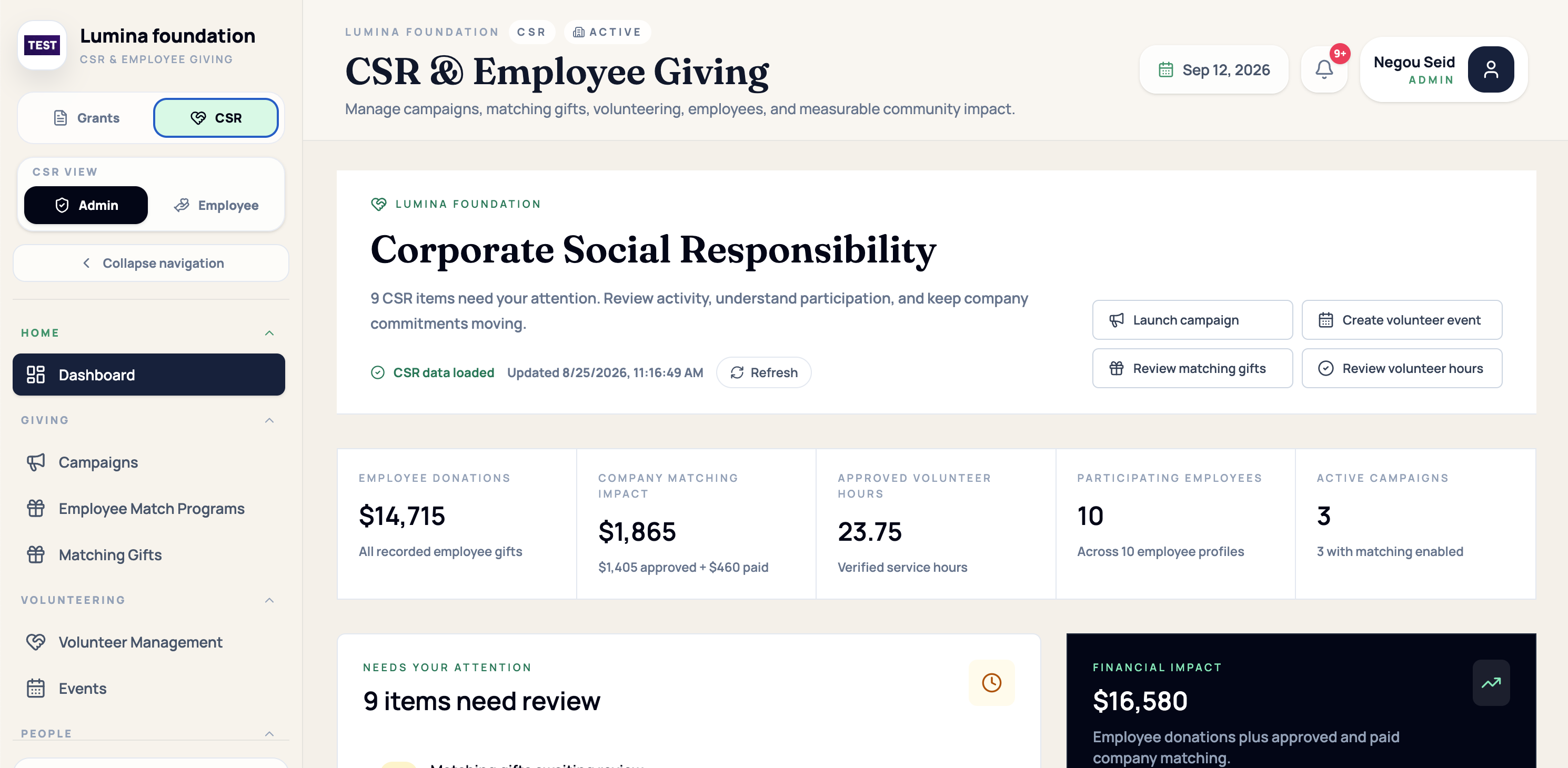
Corporate CSR command center
A first-party FoundationOS product capture connecting employee giving, company matching, volunteering, campaigns, and administrator follow-up. The workspace contains sample data.
Capability matrix
Foundation grants and employee CSR: connected, not collapsed
The platform shares nonprofit identity, governance, and reporting context while preserving the controls each program requires.
| Capability | Foundation grants | Employee CSR | Shared layer |
|---|---|---|---|
| Entry point | Application or invitation | Employee discovery and participation | Verified nonprofit record |
| Eligibility | Program criteria and due diligence | Giving, matching, and volunteer policy | Organization status and restrictions |
| Decision path | Staff, reviewer, committee, or board | Rules, evidence, and administrator approval | Roles, exceptions, and activity history |
| Money record | Award, schedule, and payment readiness | Employee gift, company match, or incentive | Legal entity, funding source, and finance status |
| Evidence | Application, agreement, reports, and amendments | Receipt, match request, attendance, or hours | Documents, identifiers, and timestamps |
| Follow-through | Requirements, reports, amendments, and closeout | Match status, campaign progress, and verification | Tasks, communications, and audit context |
| Reporting | Awards, payments, obligations, and outcomes | Participation, gifts, matches, and hours | Defined measures with source-record drill-down |
Sample reporting output
Example reconciled nonprofit relationship output
Illustrative sample — not customer data or a live dashboard
A combined report can put activities side by side without adding unlike measures into one misleading total. Each row retains its own amount or unit, status, and reporting basis.
| Activity | Measure | Status | Reporting basis |
|---|---|---|---|
| Foundation grant | $250,000 awarded | Approved | Award decision date |
| Employee donations | $18,420 contributed | Settled | Transaction date |
| Company matches | $14,860 funded | Approved | Approval date |
| Volunteer service | 386 hours | Verified | Event date |
Implementation timeline
A controlled implementation sequence
Illustrative sequencing only. Scope, data quality, integrations, policy complexity, and security review determine the actual schedule.
Weeks 1–2
Discover and design
Map grant and employee workflows, systems of record, roles, reports, exceptions, and acceptance criteria.
Weeks 2–5
Configure and migrate
Configure one controlled program, import representative active records, and establish finance and identity handoffs.
Weeks 5–7
Validate and train
Test permissions, calculations, exceptions, corrections, exports, reconciliation, and owner readiness.
Weeks 7–8
Launch and review
Release to a limited audience, monitor real work, resolve gaps, and approve the next expansion.
Primary sources
References used for the evaluation framework
- The Grant Lifecycle ↗
Grants.gov
Primary federal reference for pre-award, award, post-award reporting, and closeout stages.
- Tax Exempt Organization Search ↗
Internal Revenue Service
Primary source for tax-exempt status, filings, Pub. 78 data, and revocation information.
- Grants by private foundations: Expenditure responsibility ↗
Internal Revenue Service
Primary reference for procedures, grantee reporting, and grantor reporting in applicable cases.
- Role-based access control (RBAC) ↗
National Institute of Standards and Technology
Primary reference for assigning permitted actions through organizational roles.
Frequently asked questions
Corporate foundation software questions
What is corporate foundation software?
It is an operating platform for institutional grantmaking and related corporate-impact programs such as employee giving, matching gifts, volunteering, incentives, nonprofit relationships, and impact reporting.
Should grants and employee giving use the same workflow?
No. They can share nonprofit identity, funding dimensions, governance, and reporting, but applications, review, matching, volunteering, evidence, permissions, and communications require different workflows.
Does corporate foundation software replace accounting or payroll?
Usually not. It should manage program operations and approved handoffs while accounting remains the financial book of record and payroll or HR systems remain authoritative for employee data.
What should a corporate foundation test in a software demonstration?
Test one grant and one employee match end to end, including eligibility, conflicts, evidence, limits, approvals, corrections, payment failure, reporting, reconciliation, permissions, and a complete export.
How should combined corporate-impact reporting work?
Keep grants, corporate donations, employee contributions, company matches, incentives, and volunteer hours as separately defined measures, then provide combined views that remain traceable to source records.